
Electric skateboard or e-scooter for the daily commute? We build electric skateboards, so you can guess our favourite. But a commute is not a test ride. It is the same trip, twice a day, in every kind of weather, with a bag on your back and a meeting at 9. So in this article we compare the two honestly, with the numbers that matter for commuters: cost per kilometre, range, comfort, safety and daily use. Where an e-scooter is the better tool, we say so.
The short answer:
- Cost per km: both are very cheap to run. On the makers' own figures, the electricity for 100 km costs well under one euro for a scooter and for every ONSRA board. The scooters in our comparison use a bit less energy per km than our boards.
- Range: a typical commuter e-scooter and a mid-size board are in the same league. Our VELAR 2.0 has the most range in this comparison.
- Comfort and fun: a scooter is easier: you stand, hold the bar and go. A board takes practice, but carving to work is a different feeling, and big air tires make it smooth.
- Daily use: a board is lighter to carry and easier to store. Our Challenger 2.0 Street weighs 9.9 kg. The two scooters in our table weigh 19 and 24.25 kg.
- Rules: e-scooters and electric skateboards are treated differently from country to country, and sometimes from city to city. Check your local rules before you commute on either.
Can an electric skateboard keep up with road cyclists? A short ONSRA clip.
Which two scooters do we compare?
To keep this honest, we picked two popular commuter e-scooters and took every number from the makers' own spec pages:
- the Xiaomi Electric Scooter 4 Pro (2nd Gen): 468 Wh battery, approx. 60 km range, 19 kg, 25 km/h top speed, 10" tubeless tires, IPX4, approx. 9 h charging, max. load 120 kg;
- the Segway Ninebot Max G2: 551 Wh battery, approx. 70 km theoretical range (approx. 45 km at its top speed), 24.25 kg, folded 121 × 57 × 60.5 cm, front hydraulic and rear spring suspension, IPX5, approx. 5 h charging, max. payload 120 kg.
For the boards, all numbers come from our own product pages.
Cost per km: e-scooter vs electric skateboard
The running cost of both is mostly electricity. To compare, we divided the battery capacity by the listed range, which gives watt-hours per kilometre (Wh/km). Then we priced it at the EU average household electricity price of about €0.29 per kWh in the second half of 2025, according to Eurostat.
| Vehicle | Battery | Listed range | ≈ Wh per km | ≈ Electricity for 100 km |
|---|---|---|---|---|
| Xiaomi 4 Pro (2nd Gen) | 468 Wh | approx. 60 km | 7.8 | ≈ €0.23 |
| Segway Ninebot Max G2 | 551 Wh | 70 km (45 km at top speed) | 7.9–12.2 | ≈ €0.23–0.35 |
| ONSRA ZENO (99 Wh battery) | 99 Wh | 17.6 km ECO / 13.2 km BRUTALE | 5.6–7.5 | ≈ €0.16–0.22 |
| ONSRA Challenger 2.0 Street | 432 Wh | 38 km, up to 43 km | 10.3–11.7 | ≈ €0.30–0.34 |
| ONSRA BLACK Carve 4 | 777 Wh | 50 km ECO / 40 km BRUTALE | 15.5–19.4 | ≈ €0.45–0.56 |
| ONSRA VELAR 2.0 / 2.0 S | 1036 Wh | 60 km, up to 70 km | 14.8–17.3 | ≈ €0.43–0.50 |
| Average electric car (EV Database) | – | – | 191 | ≈ €5.50 |
A rough comparison: we use the nominal battery capacity and the makers' listed range. Charging losses add a little, your tariff may be very different, and your real range depends on your weight, speed, hills and temperature. The BLACK Carve 4 and ZENO ranges are rated with a 75 kg rider.
What this means for your wallet:
- Electricity is not the deciding cost. Even our biggest board needs roughly 1.5 to 1.9 kWh per 100 km. A full charge of a BLACK Carve 4 (777 Wh) costs about €0.23 at the EU average price.
- The scooters are more efficient per km. A 25 km/h scooter with small wheels uses less energy than a board built for 50 to 65 km/h with big motors. That is the honest result.
- What really costs money is the purchase and the wear parts. On a scooter that includes the brakes (the Xiaomi uses drum brakes and E-ABS). An ONSRA board brakes with its motors and gives part of the energy back to the battery, so there are no brake pads. Tires, wheels, bushings and, after many cycles, the battery wear on both. Our boards come with a 4-year warranty on the CNC trucks and 1 year on mechanical and electronic components and the battery.
Compared with driving, both are a different world: the average electric car in the EV Database uses about 191 Wh/km, so roughly 10 to 34 times more energy than our boards.
Range: how far can you commute?
On paper, the Xiaomi (approx. 60 km), the Segway (approx. 70 km, 45 km at top speed), the BLACK Carve 4 (50 km ECO) and the VELAR 2.0 (60 km, up to 70 km) are all far beyond a typical commute. The Challenger 2.0 Street with 38 km and the ZENO with up to 17.6 km are made for shorter trips or the last few kilometres from the train.
Our commuter rule of thumb: if you cannot charge at work, choose a range of at least twice your round trip. Real range in winter, uphill or at higher speed is lower than the listed number, on a scooter just as on a board.
Charging also matters if you charge at work. According to the spec pages, the Xiaomi needs approx. 9 hours and the Segway approx. 5 hours. Our Challenger 2.0 charges in about 4 hours with the included 2.5 A charger, the BLACK Carve 4 in about 3 hours with a 4 A charger, and the VELAR 2.0 in 4 to 5 hours with a 4 A charger. A full working day is enough for each of them.
Speed and rules: check before you commute
The scooters in our comparison are slower by design: the Xiaomi has a top speed of 25 km/h. ONSRA boards are faster: from 45 km/h (ZENO) to 65 km/h (VELAR 2.0) according to our product pages.
Rules for e-scooters and electric skateboards are not the same everywhere. Whether, where and how fast you may ride, and whether you need insurance, lights or a minimum age, depends on your country, region and sometimes your city. We do not give legal advice in this article: please check your local rules before you commute on either vehicle. For the board choice itself, read our guide to commuting by electric skateboard.
Comfort: standing, carving and bumps
E-scooter: you stand upright and hold a handlebar. The learning curve is very short, and a bag can hang from the bar. Small wheels feel every crack in the road, which is why many commuter scooters now have suspension, like the Segway Max G2.
Electric skateboard: you stand sideways and steer by leaning. There is nothing to hold, so you control speed and brakes with a small remote in your hand. It takes a few hours of practice, and in return the commute becomes the best part of the day. Big pneumatic tires make a huge difference here: the BLACK Carve 4 AT and the VELAR 2.0 run 200 mm air tires, and the VELAR 2.0 S adds CNC suspension trucks for rough roads. Our electric skateboard wheels guide explains the difference between street wheels and AT tires.
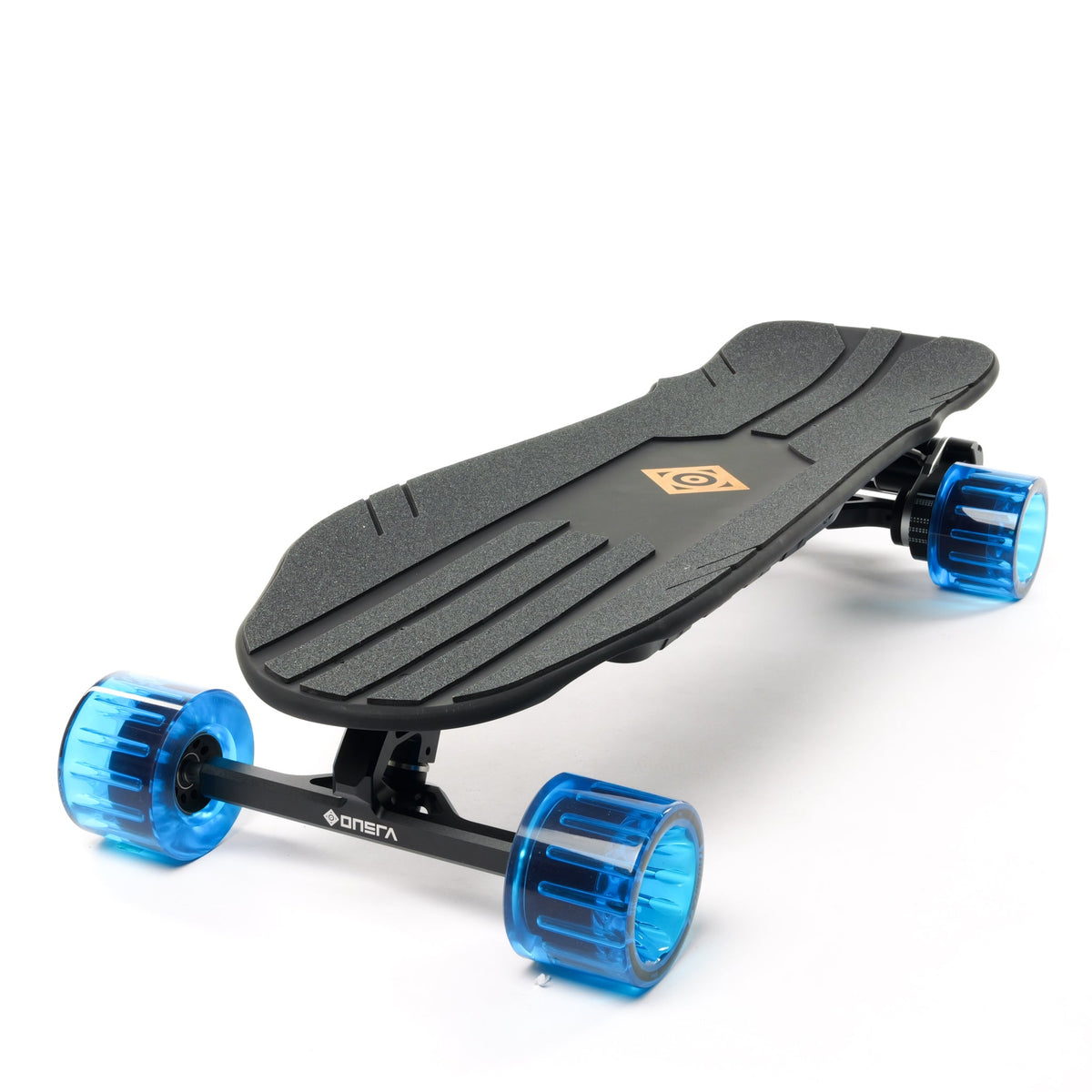
The Challenger 2.0: our compact kicktail board, 9.9 kg in the Street version.
Safety: what is different on a board?
Neither vehicle is dangerous by itself, but the risks are different:
- Learning: a scooter is easy from minute one. On a board, learn on quiet, empty, private ground before you ride anywhere else. If you are new, read why we recommend big air tires for beginners.
- Braking: a board brakes with the motors through the remote. Practise braking until it is automatic. Our guide to braking on an electric skateboard shows how.
- No handlebar: if you fall from a board, you land on your hands first. Wear a helmet, and wear gloves with palm protection. Our guide to skateboard gloves explains what to look for. For longer, faster commutes, an armored jacket like our ULTRALIGHT jacket adds back and shoulder protection.
- Be seen: a board has no built-in lights, so ride with lights and reflective clothing in the dark.
- Signal loss: if an ONSRA NX remote loses its signal, the board brakes gently instead of switching off.
- Rain: the Xiaomi is rated IPX4 and the Segway IPX5. Our boards have IP65 enclosures sealed with O-rings. That does not make any of them rain vehicles. After a ride in the rain, open your ONSRA board and let it dry completely, and check the enclosure screws from time to time: they are secured with Loctite from the factory, but a loose screw lets water in. Wet roads are also slippery, on any vehicle. More in our article on why ONSRA boards are more water-resistant.
Daily use: stairs, trains and the office
This is where a board wins for many commuters:
| Weight | Max. rider weight | Charging | |
|---|---|---|---|
| Xiaomi 4 Pro (2nd Gen) | 19 kg | 120 kg | approx. 9 h |
| Segway Ninebot Max G2 | 24.25 kg | 120 kg | approx. 5 h |
| ONSRA ZENO | 6.5 kg (99 Wh) | 100 kg | – |
| ONSRA Challenger 2.0 Street | 9.9 kg | 150 kg | about 4 h (2.5 A) |
| ONSRA BLACK Carve 4 Street / AT | 15.5 / 15.8 kg | 150 kg | about 3 h (4 A) |
| ONSRA VELAR 2.0 / 2.0 S | 18.4 / 20 kg | 220 kg | 4 to 5 h (4 A) |
You carry a board by the truck or under your arm, it stands in a corner of the office or slides under the desk, and it fits on a train without folding. A folded Segway Max G2 is still 121 cm long and 60.5 cm high. If you combine car or train with the last few kilometres, a light board is simply easier. We measured this in detail in our article on the portable electric skateboard.
A scooter wins when you carry a lot: a bag hanging from the handlebar, a big backpack, or a commute where you never have to lift the vehicle.
Which one should you choose?
| Your commute | Our honest pick | Why |
|---|---|---|
| Short, flat, you never want to practise | E-scooter | Easiest to learn, handlebar, carries luggage |
| Train + last few km | ONSRA ZENO or Challenger 2.0 Street | 6.5 to 9.9 kg, easy to carry and store |
| 10 to 25 km each way on roads | BLACK Carve 4 Street | 777 Wh, 15.5 kg, about 3 h charging |
| Bad roads, cobbles, gravel | BLACK Carve 4 AT or VELAR 2.0 S | 200 mm air tires, suspension trucks on the 2.0 S |
| Long commute or heavier rider | VELAR 2.0 | 1036 Wh, up to 70 km, up to 220 kg rider weight |
If you are also considering a self-balancing board, we compared that in Onewheel vs electric skateboard.
ONSRA boards for commuting: prices
- ZENO: 6.5 kg with the 99 Wh battery, up to 45 km/h, from $990.
- Challenger 2.0 Street: 9.9 kg, 432 Wh, 38 km (up to 43 km), $1,390.
- BLACK Carve 4 Street: 15.5 kg, 777 Wh, 62 km/h, $1,690.
- BLACK Carve 4 AT: 15.8 kg on 200 mm tires, $1,790.
- VELAR 2.0: 18.4 kg, 1036 Wh, 65 km/h, $2,490.
- VELAR 2.0 S: 20 kg with suspension trucks, $2,890.
Prices in this store's currency on 22 October 2026, subject to change. Please check the product page.
A short clip from our home country: why we ride electric skateboards.
FAQ
Is an electric skateboard or an e-scooter better for commuting?
It depends on your commute. An e-scooter is easier to learn and to ride with luggage. An electric skateboard is lighter to carry and store, works well with trains, and is more fun. On range and running costs, both are close.
What does an electric skateboard cost per km?
Very little. Based on battery capacity and listed range, ONSRA boards use roughly 6 to 19 Wh per km. At the EU average household price of about €0.29 per kWh (Eurostat, second half of 2025), that is roughly €0.16 to €0.56 of electricity per 100 km.
Is an e-scooter cheaper to run than an electric skateboard?
Slightly, on electricity. The Xiaomi 4 Pro (2nd Gen) uses about 7.8 Wh per km on its listed range, our boards 6 to 19 Wh per km. In money, the difference is a few cents per 100 km. Purchase price and wear parts matter much more.
Which has more range, an e-scooter or an electric skateboard?
It depends on the model. The Xiaomi 4 Pro (2nd Gen) lists approx. 60 km and the Segway Max G2 approx. 70 km. Our VELAR 2.0 lists 60 km, up to 70 km, the BLACK Carve 4 50 km in ECO mode and the Challenger 2.0 Street 38 km.
Is an electric skateboard lighter than an e-scooter?
In our comparison, yes. ONSRA boards weigh 6.5 to 20 kg. The Xiaomi 4 Pro (2nd Gen) weighs 19 kg and the Segway Max G2 24.25 kg.
Is an electric skateboard harder to learn than an e-scooter?
Yes. A scooter has a handlebar, so most people ride it within minutes. A board needs a few hours of practice. Big pneumatic tires, a long wheelbase and practising braking make it much easier.
Can I commute on an electric skateboard in the rain?
We do not recommend it. Our boards have IP65 enclosures sealed with O-rings, but no electric skateboard is a rain vehicle and wet roads are slippery. If you get caught in the rain, open the board afterwards and let it dry completely.
Are electric skateboards and e-scooters allowed on public roads?
That depends on where you live. Rules differ by country, region and sometimes city, and they are often different for e-scooters and electric skateboards. Please check your local rules before you commute.

BLACK Carve 4 vs VELAR 2.0 and 2.0 S: Which ONSRA Board Is Right for You?