
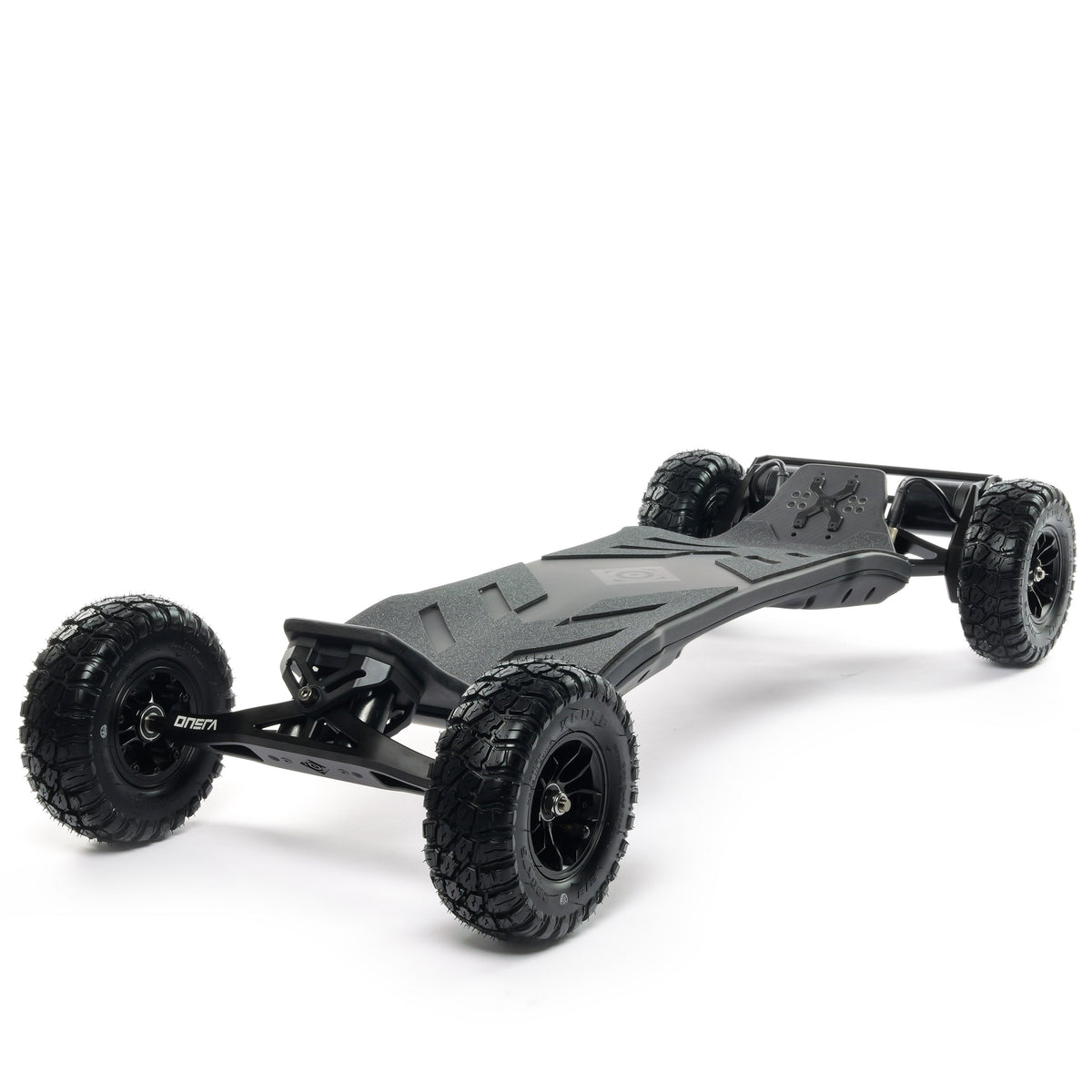
Most people shopping for their first electric skateboard picture something small and light with hard street wheels. It looks simple, so it must be easy. In our experience it's the other way around. For most first-time riders, the easiest electric skateboard to ride is an off-road board: a longer deck on big, air-filled all-terrain tires.
This guide is the beginner's side of the street-vs-off-road question. It explains why pneumatic tires make learning safer and more relaxed, where polyurethane (PU) street wheels are honestly better, and which ONSRA board fits your first rides. For the full technical comparison of wheel types, sizes and durometer, see our electric skateboard wheels guide.
The short answer: if you've never ridden an electric skateboard, start on big pneumatic tires. Switch to PU street wheels once you're comfortable on a board and know your roads are smooth.

Why most ONSRA boards ship on off-road tires
Four of our seven current board models come on pneumatic all-terrain tires out of the box:
- VELAR 2.0: 200 mm pneumatic AT wheels
- VELAR 2.0 S: 200 × 75 mm pneumatic AT wheels and suspension trucks
- BLACK Carve 4 AT: 200 mm tires
- Challenger 2.0 AT: 155 mm new-generation HOTA tires
The other three roll on solid wheels: the BLACK Carve 4 Street on 115 mm rubber wheels, the Challenger 2.0 Street on 100 mm TARMAX PU wheels, and the ZENO on 75 mm PU hub-motor wheels.
That split isn't an accident. In our store, riders can test every board we make, and Fabian talks to those customers every day. In his words: "When they test street wheels, they will not choose them because it's generally just a little bit harder to ride."
PU vs off-road wheels at a glance
| PU (urethane) street wheels | Pneumatic off-road tires | |
|---|---|---|
| Typical size on our boards | 75 to 100 mm | 155 to 200 mm |
| Cracks, gaps, small stones | Can catch, you feel everything | Roll over them |
| Comfort on rough asphalt | Firm, lots of vibration | Air cushion, much smoother |
| Gravel, grass, dirt | Not made for it | Made for it |
| Range | Higher | Lower (depends on pressure) |
| Weight | Lighter | A little heavier |
| Carving feel | Direct, precise, close to the ground | Smooth, planted, higher deck |
| Maintenance | Almost none | Check the pressure, possible flats |
| Best for | Riders who already ride, smooth roads | First rides, mixed and rough roads |
6 reasons off-road wheels make learning easier
1. Cracks and small stones stop being scary
For a beginner, the scariest moments rarely happen at top speed. They happen when a small wheel drops into a crack, hits a pebble or catches the edge of a manhole cover. A big pneumatic tire simply rolls over that kind of surface. On one of our mountain test rides on AT wheels, Fabian summed it up: "you don't really have to care about holes," and he felt "literally able to ride anywhere."
That's also why an off-road board makes everyday city riding easier, not just trail riding. Expansion joints, patched asphalt and cobblestones become part of the ride instead of a reason to tense up. Watch the short riding over a really bumpy obstacle to see what air tires can absorb.
2. Bigger wheels mean a more comfortable ride
A larger tire flattens out bumps that a small solid wheel passes straight into your feet. Width matters too. In our 200 × 75 mm tire test on the VELAR 2.0, Fabian points out that moving from the narrower VELAR 1.0 tire to the wider 2.0 setup "made a huge difference to how comfortable the board rides." His own preference: "I would rather ride a bit more comfortable than get more range."
3. A relaxed body controls the board better
Comfort isn't a luxury when you're learning. Constant vibration makes you stiffen your legs, and stiff legs are exactly what you don't want: they pass every bump into the deck and make wobbles worse. On air tires you stay loose, bend your knees and actually feel what the board is doing. Our guide to electric skateboard speed wobble explains why relaxed riders are stable riders.
4. More grip when the surface isn't perfect
Real roads have sand, wet leaves, dust and gravel at the edge. The bigger contact patch and tread of an all-terrain tire give you more grip on those surfaces, and that grip is what lets you brake calmly. Every ONSRA board has regenerative braking, and on the VELAR 2.0 you can adjust braking and acceleration from 10 to 100%. Learn the basics in how to stop an electric skateboard.
5. You can learn away from traffic
With off-road tires you aren't limited to perfect asphalt. Gravel paths, park paths, quiet farm roads and forest tracks all become places to practice, without cars and without the pressure of a busy bike lane. Later, the same board takes you onto trails, like this tight grass trail on AT wheels.
6. Longer off-road boards feel calmer
Our big AT boards also have long wheelbases: 96.5 cm (38 in) on the VELAR 2.0 and VELAR 2.0 S, and 100 cm (40 in) on the BLACK Carve 4. A long wheelbase reacts more calmly to small steering inputs, which is exactly what you want while your balance is still developing. On the VELAR 2.0, the CNC channel trucks and the low-flex carbon deck are built for stability and control.

Small and light isn't easier: the ZENO example
The ZENO is our smallest board. It weighs 5.5 kg (12 lb) without the battery, has a 48 cm (18.9 in) wheelbase, 75 mm PU wheels and a kicktail, and its 99 Wh battery is approved for air travel. It's a fantastic board for travel and city hopping.
But small doesn't mean easy. Fabian puts it bluntly: the ZENO is very small, and it's harder to ride than any of our off-road boards. Short wheelbase plus small hard wheels means quick steering and every crack under your feet. If you've never ridden before, make the ZENO your second board, not your first.

The same logic applies to the Challenger 2.0 AT. It's a short kicktail board that sits high on its tires. Fabian loves it, but in our Challenger AT mountain climb video he says it isn't the one he recommends to starters. On a short kicktail deck, ride height matters as much as the tires. For a first board, our longer AT boards are the safer choice.
Where PU street wheels are better (honestly)
PU wheels aren't bad wheels. They're the better choice for some riders and roads:
- More range. Solid wheels roll with less resistance. The Challenger 2.0 AT product page lists 24 km (15 mi) on 150 mm AT wheels and 38 km (24 mi) with street wheels.
- Lighter. The Challenger 2.0 Street weighs 9.9 kg (21.8 lb), the AT version 10.1 kg (22.2 lb). Small boards like the ZENO are lighter still.
- Precision. A low, direct board carves sharply and gives you more road feel. Experienced carvers love that.
- No flats, no pressure checks. Mount and ride.
Our TARMAX wheel shows how far PU has come: 76A on the inside for range, 72A on the outer edge for grip in carves. And if you want street wheels with more comfort, the 70A 115 mm rubber wheels on the BLACK Carve 4 Street are the smoothest street wheels we've ridden. They even handle cobblestone streets.
Our recommendation is simple: PU street wheels are for people who have already ridden a board before. If that's you and your roads are smooth, a street setup gives you more range and a lighter board. If not, start on air.
We compare both setups for experienced riders in Street vs All-Terrain Wheels.
"What about flats?" Air tires without the worry
Flats are the most common reason beginners hesitate. Three things make them a small issue:
- Thick tires. The New Generation HOTA 155 mm tire has an 8 mm tread and 7.5 mm sidewalls, and you can still ride even if the tube fails. In our video, we let all the air out of all four tires and kept riding. More in Flat? Keep Going!.
- Pressure is your comfort setting. Softer tires are more comfortable and grip better; harder tires roll further and faster. For the KGUSA 200 × 75 mm tire, the product page recommends about 35 PSI (2.4 bar) for off-road and up to 50 PSI (3.45 bar) for maximum range. Never go above the maximum on the sidewall.
- Easy repairs. Spare inner tubes are inexpensive, and our wheels guide shows how to fix a flat step by step.

Which ONSRA board for your first rides?
| You are... | Our pick | Why |
|---|---|---|
| New to e-skate, mixed city roads with cracks | BLACK Carve 4 AT | 200 mm tires, 100 cm wheelbase, up to 50 km (31 mi) range in ECO |
| New, want maximum comfort, hills and gravel | VELAR 2.0 | 200 mm pneumatic tires, 96.5 cm wheelbase, braking and acceleration adjustable from 10 to 100% |
| New, want the softest ride | VELAR 2.0 S | 200 × 75 mm tires plus suspension trucks |
| Already ride kicktail boards, need something portable | Challenger 2.0 AT | 155 mm HOTA tires on a 10.1 kg kicktail board |
| Experienced, mostly smooth roads, want range | Challenger 2.0 Street or BLACK Carve 4 Street | 100 mm TARMAX or 115 mm rubber |
| Experienced, travel a lot | ZENO | 5.5 kg, 99 Wh flight-safe battery |
A note on the VELAR 2.0 and VELAR 2.0 S: both are set up for 200 mm pneumatic all-terrain tires. Please contact us before fitting any other wheel.
Beginner tips for your first off-road board
- Start slow. Use the lowest speed mode and soft acceleration on your ONSRA NX remote until starting and stopping feel automatic.
- Run a little softer. Slightly lower tire pressure means more comfort and grip while you learn. Stay within the range printed on the tire.
- Set the trucks firm. Tighter bushings make the board calmer. Our speed wobble guide shows how to adjust them.
- Practice braking early. Brake progressively, never suddenly. See how to stop an electric skateboard.
- Wear the gear. A helmet, gloves and ideally armor. Our RACE gloves have palm sliders and a wrist protection insert, and the ULTRALIGHT ONSRA Armored Jacket has removable protectors in the shoulders, elbows and back.

The bottom line
The board that looks easiest isn't always the easiest to learn on. Big pneumatic tires forgive cracks, gravel and imperfect technique. They keep you comfortable and relaxed, and they let you practice away from traffic. That's why most ONSRA boards ship on off-road tires. PU street wheels are lighter, more efficient and more precise, and they're the right next step once you've already ridden a board and your roads are smooth.
FAQ
What is the easiest electric skateboard to ride for a beginner?
For most beginners, a longer off-road board on big pneumatic tires. The tires roll over cracks and small stones, the air cushion keeps the ride comfortable, and a long wheelbase feels calm. From our range, the BLACK Carve 4 AT, VELAR 2.0 and VELAR 2.0 S are the boards we recommend for first rides.
Are off-road electric skateboards good for beginners?
Yes. Customers who test both in our store usually choose all-terrain tires, because street wheels are a little harder to ride. Off-road tires forgive bad surfaces and give more grip, which helps while you learn balance and braking. On short kicktail boards, the higher ride height takes some getting used to.
Pneumatic vs urethane wheels: which is better for beginners?
Pneumatic tires. Urethane (PU) wheels are lighter, more efficient and more precise, but they pass every crack and vibration to your feet. We recommend PU street wheels for people who have already ridden a board before.
Are bigger wheels more comfortable on an electric skateboard?
Yes. A bigger tire rolls over bumps and cracks instead of dropping into them, and a pneumatic tire adds an air cushion. Width helps too: going to a wider tire on the VELAR 2.0 made a huge difference in ride comfort in our tests.
Is a small electric skateboard easier to learn on?
Not necessarily. Small boards are easier to carry, but a short wheelbase and small wheels make them quicker to steer and more sensitive to the road. Our ZENO is very small and harder to ride than any of our off-road boards.
Do all-terrain tires get flats?
They can, like any air-filled tire. Thick tires such as the New Generation HOTA 155 mm, with 7.5 mm sidewalls, can still be ridden if the tube fails. Check the pressure before you ride and keep a spare tube.
Do off-road tires reduce range?
Yes. Pneumatic tires roll with more resistance than PU wheels, and lower pressure costs more range. The Challenger 2.0 AT page lists 24 km on 150 mm AT wheels and 38 km with street wheels. Pump the tires harder, within the maximum on the sidewall, when range matters most.
Can I switch to street wheels later?
It depends on the board. Belt-drive boards often can with the right wheel pulley. The current VELAR 2.0 and VELAR 2.0 S are set up for 200 mm pneumatic tires, so please contact us before fitting any other wheel. Our wheels guide covers compatibility in detail.

Best Electric Skateboard Black Friday Deals 2026: Real Prices, Live Now
Why ONSRA Electric Skateboards Are More Waterproof: The O-Ring Sealing Explained